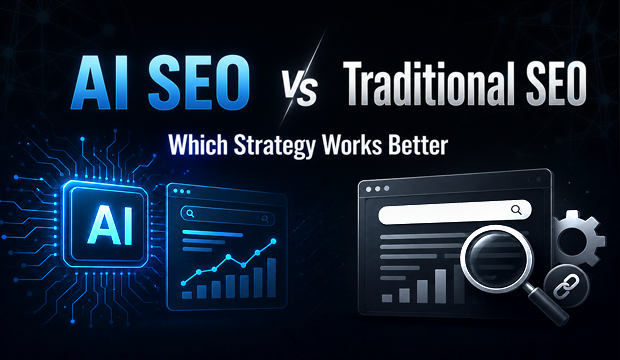
AI is transforming how companies approach search optimization. From keyword research and content planning to data analysis, AI is enabling marketers to work faster and make better decisions. Meanwhile, more traditional SEO remains time-tested for establishing authority, trust, and long-term visibility.
At Digital Hub Solution, we are frequently asked by clients about which method is better for results-based marketing. The fact is, each has its advantages, and knowing how they function can enable businesses to develop a more powerful search strategy.
Search is evolving so much faster than people realized. Google isn’t just matching keywords anymore. It observes intent, context, and topic depth. A page of the right words, but with no real substance, doesn’t get you anywhere nowadays.
Add that to the pressure most businesses are under - Leads, visibility, staying ahead of whoever is chasing them. So, when AI tools promised to turn weeks of research into hours, people listened, and they should have. That part is true, but AI can’t replace the strategy behind it all, and that still requires humans.
Before AI tools existed, companies built search rankings by doing the work. Writing genuinely useful content. Fixing technical issues that blocked crawlers. Earning links from sites that actually mattered to their audience. It wasn't the fastest approach, but it consistently delivered long-term results.
Effective SEO Services typically focus on:
Technical website optimization
High-quality content creation
On-page SEO improvements
Link-building strategies
User experience enhancements
None of these has become less important. What's changed is how fast you can execute them. Traditional SEO takes time. Three months before you see meaningful movement is common, but the rankings it builds don't collapse when an algorithm update rolls out.
AI tools are genuinely good at one thing: processing volume. Keyword data, competitor content, and search trend patterns, a task that used to take a skilled analyst two days, now takes twenty minutes.
More businesses are now investing in AI SEO services specifically because of that speed advantage.
AI can support optimization efforts by:
Identifying keyword opportunities
Analysing competitor content
Detecting content gaps
Predicting search trends
Improving content recommendations
The practical effect is that your team makes better decisions, faster. You stop guessing which content to prioritize. You see gaps competitors haven't filled. That kind of clarity is worth a lot, especially in fast-moving industries.
Not a shortcut to rankings, just faster inputs into the process. AI shortens the research phase significantly. Content planning that used to require a week of manual analysis now produces a full quarter's roadmap in a day.
Technical audits are another area. AI-powered tools flag crawl issues, page speed problems, and structural gaps quicker than manual crawls ever could. For large websites with hundreds of pages, that's not a small advantage.
What it doesn't do is write content that earns trust or build the relationships needed for real link acquisition. Those still require people.
Real experience and expertise often provide industry-specific knowledge, practical understanding, and valuable perspectives. AI can assist with content creation, but human input is still necessary for depth and credibility.
Traditional optimization also excels in areas such as:
Building genuine authority
Creating trustworthy content
Developing long-term link-building strategies
Understanding industry-specific nuances
A good SEO professional who knows your market understands things that don't appear in a dataset. Which topics does your audience actually care about? What a "good" backlink looks like in your niche specifically. When to hold off on targeting a keyword because the search intent doesn't match what you sell. These judgment calls matter more than most people realize.
Traditional search results are no longer the whole game. Voice assistants answer questions without showing a list of links. AI search platforms summarize topics and cite sources directly. If your content isn't structured to feed those systems, you're invisible to a growing portion of how people look for information.
This shift has increased the importance of AEO Services and GEO Services.
AEO Services specializes in content optimization for the direct answers, featured snippets, and voice results. Search engines Favor content that has clear, specific answers and well-organized information for their users.
Meanwhile, GEO Service is also enabling businesses to boost visibility in AI-generated search experiences. To be cited as a source of content on AI platforms, businesses must earn authority, publish high-quality information, and demonstrate consistency over time.
Both matter now, not as a future consideration, but as a present.
The answer is no, while AI can streamline many SEO tasks and provide valuable insights, it cannot replace the human expertise required to build an effective search strategy. Understanding customer behaviour, identifying emerging market trends, and creating content that genuinely connects with an audience often require experience and strategic thinking.
AI works best as a supporting tool, while human input remains essential for delivering meaningful and long-term results.
Many businesses view AI SEO and traditional SEO as competing strategies, but the most effective approach is often a combination of both. Traditional SEO provides a strong foundation for long-term growth, while AI helps streamline processes, improve efficiency, and uncover valuable opportunities more quickly.
At Digital Hub Solution, we combine SEO Services, search engine marketing services, AEO Services, and GEO Services into strategies built for where search actually is today, not where it was five years ago. By combining human expertise with AI-driven insights, we help businesses make informed decisions while adapting to changing search trends.
AI has made SEO faster. It hasn't made traditional SEO irrelevant. The businesses doing well in search right now are the ones that understood this early: use AI to work smarter, use human expertise to work better; neither alone is enough. Together, they're a real competitive advantage.
Each does something different well. AI accelerates research and analysis. Traditional SEO builds the authority and trust that rankings are actually based on.
Tools and processes that use artificial intelligence to speed up keyword research, content planning, competitor analysis, and technical SEO audits.
Yes. SEO Services remain essential for improving organic visibility, attracting qualified traffic, and building long-term authority across search engines and AI-driven search experiences.
They optimize content to appear in direct answer formats, featured snippets, and voice search results, which are increasingly how people consume information.
GEO Services help businesses improve visibility in AI-generated search results by building authority, enhancing content quality, and increasing the chances of being referenced.
 +919560508412